












What Happened to the Village?
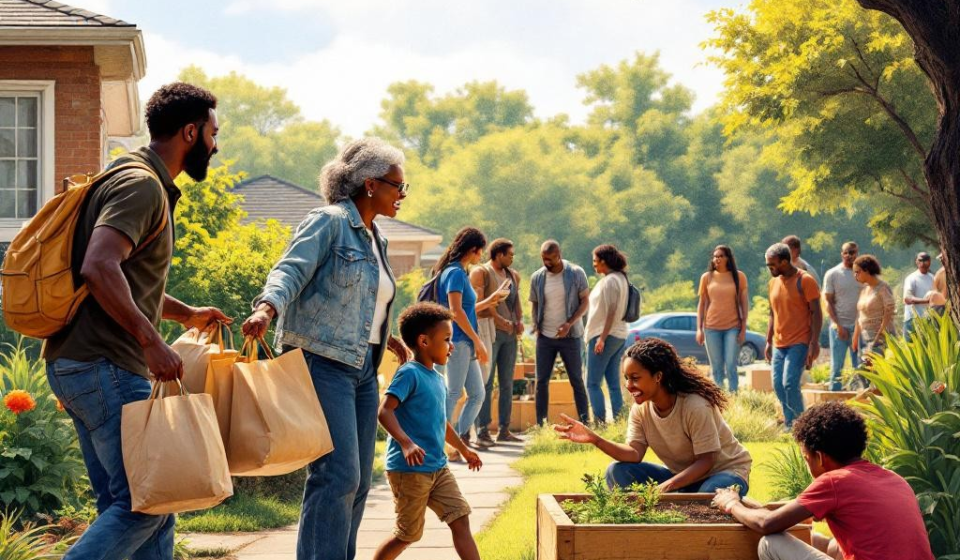
There was a time when communities really felt like villages.
If you saw a child walking to school, you watched to make sure they got there safely. If you saw someone’s child doing something wrong, you spoke up—not to embarrass them, but to guide them. Parents knew that extra eyes and extra hearts were a blessing, not a threat. Families looked out for each other, and that took some of the pressure off parents because they weren’t doing it alone.
Now, it feels like those days are disappearing.

Today, it’s “don’t talk to my child,” “don’t correct my child,” “don’t say anything about my child.” Even when a parent clearly sees their child doing wrong, they may attack anyone who dares to speak up. I’ve seen people say things like, “I’ll fold you over my children,” ready to fight first instead of listening. It’s heartbreaking and honestly, it’s dangerous.
When Protection Turns Into Isolation
Let me be clear: I don’t play about my sons either. I love them, and I would do anything to protect them. But there’s a difference between protection and denial.
When my sons were growing up, if someone told me they were doing something wrong, I listened. I wanted to know. I might not have agreed with every detail, but I took it seriously because I would rather correct my child than defend their bad behavior. I wasn’t quick to get angry at the person who spoke up—many times, that person was actually on my side, trying to help me raise my child well.
Now, it feels like if you say anything at all—even kindly—about someone’s child being disrespectful or out of line, you’re risking an argument or even violence. People are ready to fight or pull out a weapon over simple correction. It’s sad, and it shows how broken and alone many people feel.
Because here’s the truth:
A lot of these parents who lash out feel lonely. They are overwhelmed. They are doing everything by themselves. Deep down, they do want help, but at the same time, they don’t know how to receive it. So they push away exactly what they need.
The Power of Messages: What Are We Feeding Our Children?
I recently saw a video go viral. A toddler—still a baby, really—was standing on top of a counter. The mother was playing a song with very disrespectful lyrics, the kind of words that degrade women, calling them names and sexualizing them. And the mother was telling the child to “eat,” doing the pretend “eat with your hands” move while dancing and vibing to the music.
On the surface, sure, it looks like a cute video. A little girl dancing. A mom laughing. Everybody in the comments saying how adorable it is.
But I’m listening to the lyrics.
Words matter. Energy matters. Repetition matters. You cannot constantly pour disrespectful, sexual, degrading messages into a young child’s mind and then be surprised later when she doesn’t respect herself. You cannot cheer for lyrics that treat women like objects and then ask why your daughter grows up thinking that’s normal.
And when people tried to say something lovingly in the comments—things like “Hey, maybe change the song,” or “This isn’t really appropriate for a toddler”—the mom wasn’t open. She deleted and blocked people. She threatened to go after anyone who said anything “negative.”
So what message is that sending?
1. That anything “fun” is automatically harmless.
2. That anyone who disagrees is a “hater.”
3. That correction is an attack, not an act of love.
When we delete every voice that challenges us, we create a fake world where bad choices seem normal, even celebrated. The subconscious mind takes that in. People begin to believe, “This is just how it is. This is okay.” But it’s not okay. And our children will be the ones paying the price later.
A Real-Life Example That Broke My Heart
Another situation really stayed with me.
One day, my son was at a store. He walked in and saw a little girl—about five or six years old—singing the lyrics to a song out loud. The song was talking explicitly about a woman’s body and how her vagina needs to “get wetter.” These are grown, sexual lyrics, coming out of a child’s mouth.
And what was the mother doing?
She was hyping her up. Cheering her on. Rooting for her because the little girl knew the words. Dancing with her. Vibing with her. Treating it like a cute performance.
My son wanted so badly to say something, but he also wanted to avoid an altercation. So instead, he simply shook his head at the mom as if to say, “No, this is not okay.” And even that small gesture made her upset. She immediately labeled anyone who disagreed as a “hater.”
But he wasn’t the only one in the store uncomfortable with what was happening. Other people saw it, too. People were disturbed. But no one wanted to speak, because nowadays, saying something—even gently—feels like you’re inviting conflict.
Again, who will suffer in the long run?
The child and the mother. The child, because she’s being sexualized and taught to disrespect herself without even understanding it. The mother, because one day she may look back and realize she was cheering for the very thing she hoped to protect her daughter from.
What Happened to the Village?
We used to be a village.
We understood that correction wasn’t judgment—it was care. If an elder or neighbor pulled a child aside and said, “Hey, that’s not how you act,” the parent didn’t automatically jump into attack mode. They might even thank them.
But today:
– If you speak on a child’s behavior, you’re “judging.”
– If you question a parent’s choices, you’re a “hater.”
– If you refuse to clap for harmful behavior, you’re “negative.”
So the village goes silent.
People stop speaking up. They look away. They say, “It’s none of my business.” And as the village disappears, children lose something priceless: a circle of protection, guidance, and love that extends beyond just their household.
The Hidden Pain Behind the Anger
I truly believe that under all this anger, there is a lot of pain.
Many parents feel:
– Overworked
– Under-supported
– Judged
– Tired of being told what to do
So when someone says something about their child, it doesn’t just hit the child—it hits all their insecurities and fears as a parent. It feels like, “You’re saying I’m failing.” And instead of pausing and asking, “Is there any truth here that might help my child?” it becomes, “Don’t you dare say anything about my baby.”
The sad part is, they are pushing away the village they secretly need.
We Need to Bring the Village Back
I’m not saying that anyone and everyone should have the right to talk to your child any kind of way. Respect matters. Tone matters. Intent matters. But so does humility. So does wisdom.
We need to find our way back to a balance where:
– Parents are still the primary authority…
– …but community guidance is welcomed, not attacked.
– Children are protected from harm…
– …but also protected from becoming harmful.
– We enjoy music and entertainment…
– …but stay mindful of the messages we’re feeding young minds.
Because children are watching.
Children are listening.
Children are absorbing.
Every lyric, every video, every “joke,” every time we defend what is clearly wrong, we are planting seeds. Those seeds grow up into beliefs, habits, and choices. And by the time we see the fruit, it’s often much harder to undo.
So I ask again:
**What happened to the days of us being a village?**
And more importantly: **Are we willing to rebuild it?**
It starts with small things:
1. Being honest about the messages in the music and media we let our kids consume.
2. Being open—at least a little—to loving correction from people who truly care.
3. Speaking up when we see something harmful, but doing it with respect, not arrogance.
4. Remembering that if someone points something out about our child, that doesn’t automatically make them an enemy.
Our children deserve more than viral moments and “cute” videos with damaging messages in the background. They deserve guidance. They deserve protection. They deserve a village.
My Gallery

Words That Inspire
The simple message of It Takes a Village is as relevant as ever: We are all in this together.”
― Hillary Rodham Clinton
Video Inspiration
Tiny Daily Habits (That Make Life 30% Less Chaotic)
Small Daily Practices
– Take 5 minutes to actually look around
Pretend you’re a tourist in your own life. Notice the light, the sounds, the weird plant in the corner you keep forgetting to water.
– Write down *one* thing you’re grateful for each night
Just one. It can be “my bed,” “coffee,” or “the fact that today is finally over.”
– Drink your coffee without your phone
Wild idea: just you, your drink, and your thoughts. (Don’t worry, the internet will still be there when you get back.)
Why It’s Not Just Fluffy Self-Help Stuff
Mindful routines are like a daily reset button.
They:
– Give your day a bit of structure (so it’s not just “wake, scroll, panic, sleep”).
– Train your brain to notice the good stuff you usually walk right past.
– Slowly turn life from a never-ending to-do list into a collection of actually meaningful little moments.
Tiny habits, big shift. One coffee break at a time. 
